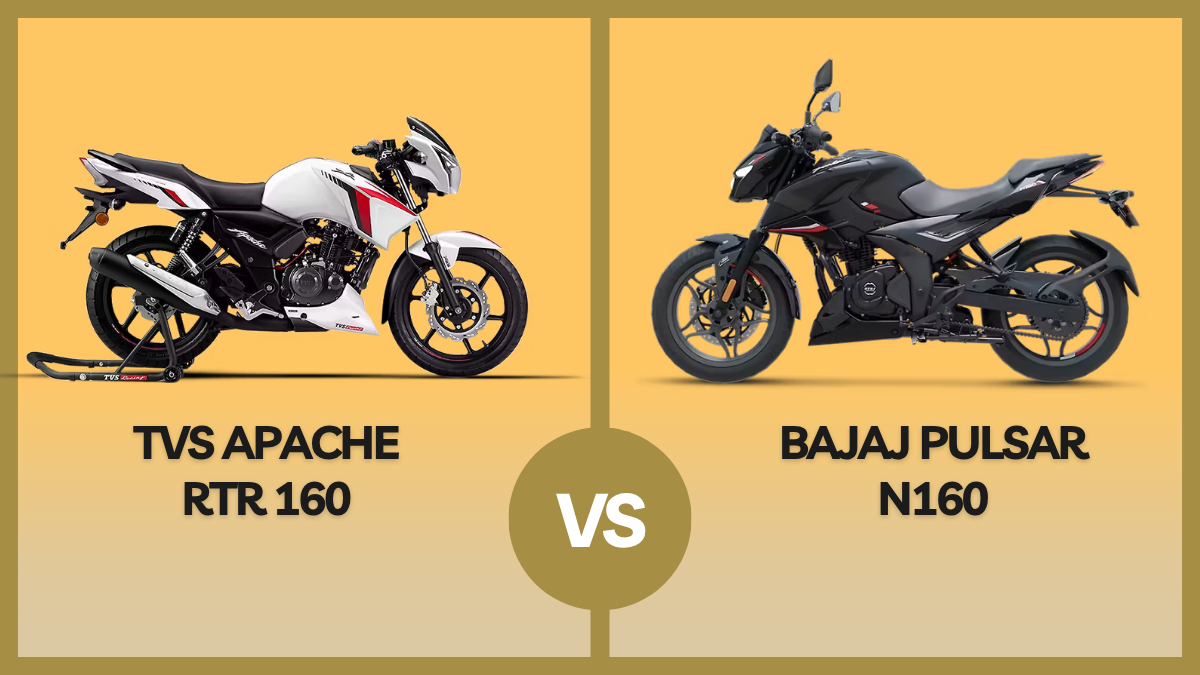
Bajaj Pulsar N1601/72Tap to zoom

Bajaj Pulsar N160

Bajaj · Motorcycle

Pulsar N160

₹ 1,16,501ex-showroom · last updated 2026

Engine
164.82cc
Power
15.68bhp
Mileage
51.6kmpl
Weight
148kg
EMI starting from ₹5,000/month · subject to bank approval
IAF

Research by

IAF Editorial

Updated

Bajaj Pulsar N160 — Overview

The Bajaj Pulsar N160 is a street bike available at a price range of Rs. 1,16,501 - Rs. 1,28,994 in India. It comes in 5 variants and 11 colours. It is powered by a 164.82 cc BS6 Phase 2 engine and has a expert reported mileage of 51.6 kmpl. With both front and rear disc brakes, the Bajaj Pulsar N160 comes with anti-locking braking system. The Pulsar N160 bike weighs 148 kg and has a fuel tank capacity of 14 liters. It develops a power output of 15.68 bhp and a torque of 14.65 Nm.

In December 2025, Bajaj quietly did something the 160cc segment had never seen - they gave the Pulsar N160 gold USD forks, three ABS modes (Road, Rain, Off-road), and a single-seat stance at Rs 1,28,994. That's hardware borrowed straight from the N250, dropped into India's most competitive commuter-sport segment. The N160 has always punched above its price with its N250-inspired design and genuinely refined 165cc motor, but this latest update makes it the most well-equipped sub-Rs 1.30 lakh street-naked you can buy right now.

Bajaj Pulsar N160 Latest Updates

View all
  • Bajaj launched the 2026 Pulsar N160 with refreshed graphics and new decals - featuring updated 'N160' and '160' sticker designs with neon accents - with no mechanical changes. The 2026 model is available in Brooklyn Black, Racing Red, Pearl Metallic White, and Grey.

  • Bajaj marginally hiked the Pulsar N160 base variant (Single Channel ABS - Single Seat) price by Rs 702, bringing it to Rs 1,16,501 ex-showroom. No price changes were made to the higher variants.

What We Like

  • Smooth, refined 165cc engine with almost zero vibrations even at high RPM - noticeably better than the NS160 it replaced
  • Dual-channel ABS with 3 modes (Road, Rain, Off-road) on USD fork variants - unique in this price bracket
  • N250-inspired muscular design with sharp headlamp and sculpted tank shrouds - looks more expensive than it is
  • Wide Bajaj service network across India with affordable parts and straightforward maintenance costs

What Could Be Better

  • Gearbox prone to false neutrals between 1st and 2nd gear - a persistent complaint across multiple owner reviews
  • Stiff seat makes rides beyond 80-100 km uncomfortable, especially on broken roads
  • Some owners report paint quality issues and engine oil seepage from early units

Editor's Verdict

Should You Buy the Bajaj Pulsar N160?

For a rider who covers 30-80 km a day in mixed city and light highway conditions and wants a bike that looks sharper than it costs - the N160 is the easiest recommendation in its segment right now. The 51.6 kmpl ARAI mileage, the Bajaj service network density, and the fact that even the base variant at Rs 1,16,501 comes with disc brakes front and rear make this a compelling daily weapon. Go for the Dual Channel ABS variant at minimum; the USD fork variants are worth the premium if your roads justify better suspension.
Latest News

See all →

Frequently Asked Questions

QWhat is the on-road price of Bajaj Pulsar N160 in Delhi and Mumbai?
The Bajaj Pulsar N160 base variant (Single Channel ABS - Single Seat) is priced at Rs 1,16,501 ex-showroom. On-road in Delhi it works out to approximately Rs 1,36,076 (ex-showroom Rs 1,16,142 + RTO Rs 9,291 + insurance Rs 10,643), and in Mumbai approximately Rs 1,36,170. The top-spec USD Fork - Dual Channel ABS - Single Seat variant is priced at Rs 1,28,994 ex-showroom.
QWhat is the real-world mileage of Bajaj Pulsar N160?
The ARAI-certified mileage of the Bajaj Pulsar N160 is 51.6 kmpl. In real-world city riding conditions, most owners report 42-46 kmpl; on the highway you can expect around 48-50 kmpl. With a 14-litre fuel tank, the realistic city riding range is approximately 580-640 km per fill-up.
QWhat is the service cost and service interval for Bajaj Pulsar N160?
The Bajaj Pulsar N160 requires servicing every 6,000 km or 6 months, whichever comes first. The first three services are free at authorised Bajaj service centres. Paid services typically cost Rs 1,000-1,500 for routine maintenance including engine oil and filter change. An annual maintenance contract (AMC) is available at approximately Rs 2,245, which covers three free services plus labour discounts.
QWhat is the EMI for the Bajaj Pulsar N160 base variant?
With a 20% down payment (approximately Rs 23,300) on the base Single Channel ABS - Single Seat variant at Rs 1,16,501, and a 36-month loan at 9-10% interest, the EMI works out to approximately Rs 3,200-3,400 per month. Bajaj Auto Credit offers finance at authorised dealerships with competitive rates for salaried buyers, often with minimal documentation.
QWhich Bajaj Pulsar N160 variant is the best to buy?
The Dual Channel ABS - Dual Seat variant at Rs 1,19,289 is the sweet spot - it adds dual-channel ABS (which modulates front and rear braking independently for better wet-road safety) over the single-channel dual-seat variant for just Rs 321 more, making it an obvious upgrade. If you ride on pothole-heavy roads or want Bluetooth and turn-by-turn navigation, the USD Fork - Dual Channel ABS - Dual Seat variant at Rs 1,24,045 is worth the stretch.
QDoes the Bajaj Pulsar N160 have dual-channel ABS?
Yes - three of the five N160 variants come with dual-channel ABS: the Dual Channel ABS - Dual Seat (Rs 1,19,289), USD Fork - Dual Channel ABS - Dual Seat (Rs 1,24,045), and USD Fork - Dual Channel ABS - Single Seat (Rs 1,28,994). The top two USD fork variants additionally offer three ABS modes - Road, Rain, and Off-road - making the N160 the only bike in the 160cc segment with this level of braking customisation.
QWhat is the difference between Bajaj Pulsar N160 and NS160?
The N160 (164.82cc, 16 PS) uses the newer N-series design language borrowed from the N250, while the NS160 (160.3cc, 17.2 PS) retains the older naked-street styling with a standard USD fork across all variants. The N160 is marginally faster in real-world 0-100 kmph tests despite lower peak power, returns slightly better mileage (46 vs 44 kmpl real-world), and offers dual-channel ABS as an option - which the NS160 does not. For most daily riders the N160 is the better-rounded choice; the NS160 suits those who prefer a more aggressive, performance-focused ergonomic.