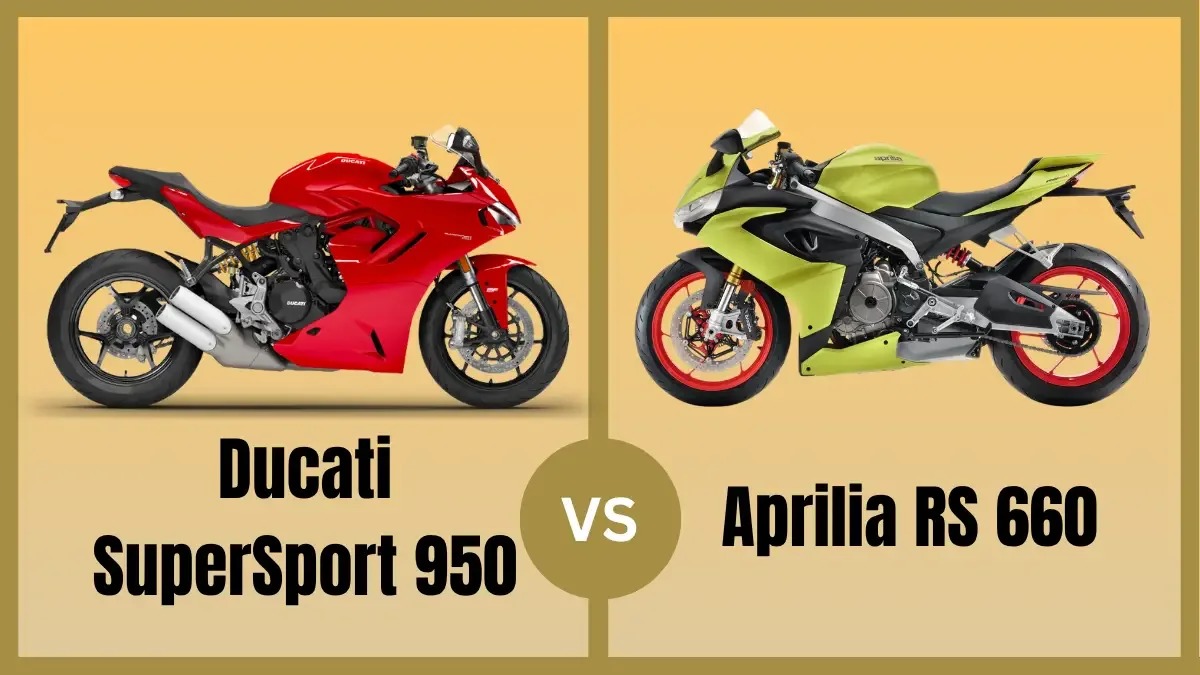

The Aprilia RS 660 versus the Triumph Daytona 660 is the most interesting premium motorcycle comparison in India right now. Both are 660cc - an identical displacement that masks completely different engineering philosophies. Both are full-fairings supersports priced within Rs 1 lakh of each other. Both are the most capable motorcycles their respective brands have offered at this price point in India.
The Italian parallel-twin versus the British triple. Weight and electronics versus engine character and sound. Here is the honest breakdown.
Price Comparison
| Aprilia RS 660 | Triumph Daytona 660 | |
|---|---|---|
| Standard | Rs 13,99,000 | ~Rs 12,95,000 |
| Top variant | Rs 15,50,000 (Extrema) | - |
The RS 660 is approximately Rs 1,04,000 more than the Daytona 660. Both are CBU imports. That gap is meaningful but not large enough to decide the comparison on its own - it comes down to what you get for the money.
Specs That Matter
| Spec | Aprilia RS 660 | Triumph Daytona 660 |
|---|---|---|
| Engine | 659cc, liquid-cooled, parallel-twin | 660cc, liquid-cooled, inline-triple |
| Max Power | 100 PS @ 10,500 rpm | 95 PS @ 11,250 rpm |
| Max Torque | 67 Nm @ 8,500 rpm | 69 Nm @ 8,250 rpm |
| ARAI Mileage | ~20 kmpl | ~22 kmpl |
| Kerb Weight | 169 kg | 177 kg |
| Seat Height | 820 mm | 835 mm |
| Front Suspension | 41mm Kayaba USD | 41mm Showa USD |
| Brakes | Brembo radial monobloc | Nissin radial |
| Slipper Clutch | Yes | Yes |
| ABS | Cornering ABS (Bosch) | Cornering ABS |
| Riding Modes | 6 (+ Individual) | 4 |
| Quickshifter | Up/Down (standard) | Up/Down (standard) |
| Launch Control | Yes | Yes |
| Cruise Control | Yes | No |
| TFT Display | 5-inch | 5-inch |
The RS 660 wins on weight (169 vs 177 kg - 8 kg less), Brembo brakes over Nissin, more riding modes (6 vs 4), cruise control, and slightly more power. The Daytona 660 wins on torque at the margin (69 vs 67 Nm), lower seat height (835 vs 820 - wait, Daytona is taller), and one thing no table can capture: the triple-cylinder engine.
The seat height note: the Daytona 660's 835mm is 15mm taller than the RS 660's 820mm. Both are tall bikes requiring riders of at least 5'7".
Engine Character: The Most Important Difference
This is where the comparison moves beyond specifications.
The Triumph Daytona 660 uses a 660cc inline triple-cylinder engine - the same basic architecture as the Street Triple and Tiger Sport 660, now tuned specifically for a supersport application with higher compression and revised intake. The triple's defining character is its sound and delivery: a distinctive mechanical howl above 8,000 rpm that builds to a crescendo at the 11,250 rpm peak. The mid-range is strong and progressive; the top-end is genuinely exciting. In the history of accessible performance motorcycles, Triumph's 660cc triple is one of the most characterful and emotive engines available.
The Aprilia RS 660's parallel-twin is the technical counterpart: RSV4-derived, precise, and powerful, but more linear and composed in its delivery. The twin's 67 Nm arrives at 8,500 rpm - the power is strong throughout the rev range, smooth rather than dramatic. It does not howl. It does not build to a spine-tingling peak. What it does do is pull seamlessly from 3,000 rpm to 10,500 rpm with a consistency that makes fast road riding feel effortless rather than exciting.
Neither is objectively better. This is genuinely a matter of riding philosophy:
- The twin rewards composed, measured riding - it makes a skilled rider feel more capable through smoothness
- The triple rewards riders who want to participate emotionally - it demands engagement and rewards it with theatre
If you have ridden both back-to-back and still cannot decide, buy the Daytona 660.
Weight: RS 660's Most Measurable Advantage
Eight kilograms less - 169 kg versus 177 kg - is the RS 660's most measurable real-world advantage. On a track or a twisting road, 8 kg less is felt in direction changes, mid-corner corrections, and the physical effort of riding quickly.
The RS 660's light weight is not accidental - it is the result of deliberate design choices influenced by the RSV4's engineering principles. The compact parallel-twin sits low and central; the frame is optimised for mass centralisation. The result is a motorcycle that feels smaller and more agile than its 100 PS and 659cc displacement would suggest.
The Daytona 660 at 177 kg is not heavy - it is lighter than the Honda CBR650R (189 kg) and Kawasaki Ninja 650 (193 kg). But against the RS 660, the additional 8 kg is a consistent disadvantage in dynamic situations.
Brakes: RS 660's Clear Win
Brembo radial monobloc front calipers on the RS 660 versus Nissin radial calipers on the Daytona 660 - this is not a close comparison. Brembo monobloc calipers are the reference standard for performance motorcycle braking worldwide. The initial bite, modulation through the lever travel, and fade resistance under repeated hard applications at track pace are simply better than the Nissin units.
For road riding, both systems are more than adequate - the Nissin setup on the Daytona will never leave a road rider wanting. At track day pace or in emergency stops on a fast road, the Brembo advantage becomes felt.
Electronics: RS 660's Depth vs Daytona's Usability
The RS 660's six riding modes (Commute, Urban, Sport, Track, Rain, Individual) versus the Daytona 660's four is a genuine feature advantage. More critically, the RS 660's Individual mode allows full independent customisation of power delivery, traction control, ABS sensitivity, and engine braking - saving the configuration for instant recall. The launch control implementation is also more sophisticated on the RS 660.
Cruise control standard on the RS 660 is an unusual feature for a pure supersport - the Daytona 660 does not have it. For riders who use their supersport on long motorway sections between city legs or track days, this is a meaningful practical benefit.
In day-to-day use, the Daytona 660's four-mode system is simpler and more immediately navigable through the menus. The RS 660's deeper system rewards riders who invest time in learning it; the Daytona's is accessible immediately.
Seat Height and Ergonomics
The Daytona 660 at 835mm is 15mm taller than the RS 660 at 820mm - both are tall, and neither is forgiving for riders below 5'7". The riding position on both is aggressive and track-oriented: low bars, rear-set footpegs, a forward lean that works on circuit and on flowing roads, and becomes uncomfortable in city stop-start traffic above 30 minutes.
Both bikes are best understood as weekend-and-track motorcycles that happen to be road-registered. Daily urban commuting is possible but not the intended brief for either.
Service Network in India
Both the Aprilia RS 660 and Triumph Daytona 660 are sold through relatively thin dealer networks in India compared to Japanese brands. Piaggio India's network is comparable in reach to Triumph India's in major metros - both cover Delhi, Mumbai, Bangalore, Pune, Hyderabad, and Chennai. Outside those cities, both become harder to service.
If you are in a metro: no meaningful difference. Outside the top 8 cities: research the nearest authorised dealer for both brands before buying either.
The Riding Experience Summary
Aprilia RS 660: The most technically accomplished 660cc motorcycle in India. Lightest in class, best brakes, deepest electronics, RSV4 DNA. Riding it feels like operating a precisely engineered instrument - everything works exactly as intended, nothing is wasted.
Triumph Daytona 660: The most emotionally compelling 660cc motorcycle in India. The triple-cylinder engine creates a riding experience that the RS 660 cannot replicate - the sound, the progression, the involvement. Riding it is the more memorable experience.
Who Should Buy Which
Buy the Aprilia RS 660 if:
- Weight matters - 8 kg less is a measurable track and dynamic advantage
- Brembo brakes are important to you
- You want the most comprehensive electronics suite in the segment
- Cruise control is useful for your riding pattern
- RSV4 engineering lineage and Italian brand identity matter
- You ride with composed precision rather than emotional involvement
Buy the Triumph Daytona 660 if:
- The triple-cylinder engine's character is the most important thing - and for many riders, it is
- You prefer Triumph's British brand identity and engineering philosophy
- Rs 1 lakh saving matters for spending on track tyres and gear
- You prefer a simpler electronics interface
- You have ridden both and the Daytona felt more alive
The Honest Take
By engineering metrics, the Aprilia RS 660 wins: lighter, better brakes, more electronics, marginally more power, cruise control. If this were decided on specification alone, the RS 660 is the superior motorcycle and the additional Rs 1 lakh is justifiable.
The Triumph Daytona 660 wins on riding experience for riders who measure motorcycles through their emotional engagement rather than their specification sheets. The triple-cylinder engine is a legitimate reason to choose the Daytona over the RS 660 - it creates a sound and delivery that has no equivalent at this price point from any other manufacturer in India.
Both motorcycles are exceptional. The RS 660 is the better supersport. The Daytona 660 may be the more memorable motorcycle. That distinction is worth sitting with before you decide.